
Title IX
Protections from harms based on gender.

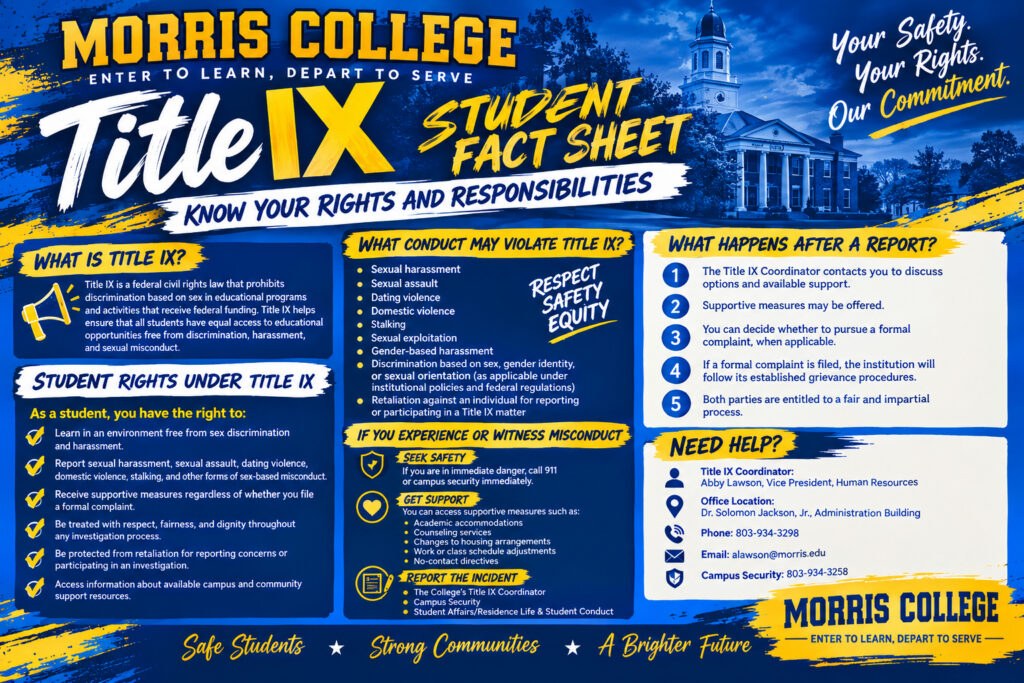
Title IX is a federal civil rights law passed as part of the Education Amendments of 1972. This law protects people from discrimination based on sex in education programs or activities that receive federal financial assistance.
Contact:
Dr. Juana Davis-Freeman, Title IX Coordinator
Phone: 803.934.3264
Email: [email protected]
Mrs. Abby Lawson, VP for Human Resources
Director of Human Resources
Phone: 803.934.3298
Email: [email protected]
Frequently Asked Questions
Title IX states: “No person in the United States shall, on the basis of sex, be excluded from participation in, be denied the benefits of, or be subjected to discrimination under any education program or activity receiving Federal financial assistance.”
Title IX applies to any institution receiving federal financial assistance from the Department of Education, including state and local educational agencies. Educational programs and activities that receive federal funds from the Department of Education must operate in a nondiscriminatory manner. Also, a recipient may not retaliate against any person for opposing an unlawful educational practice or policy, or because a person made charges, testified or participated in any complaint action under Title IX.
The college is obligated to provide a prompt, thorough and equitable investigation of any report of sex-based discrimination, sexual harassment, or sexual violence. This obligation remains even in the absence of a formal complaint.
Title IX ensures that both parties in a reported event have equal opportunity to be heard and participate in a grievance process.
Congress enacted Title IX to prohibit sex discrimination in any education program or activity—public or private—receiving federal funds. The Department of Education’s Office for Civil Rights (OCR) is the primary federal agency responsible for enforcing Title IX.
Title IX’s prohibition against sex discrimination is broad, protecting students, faculty, and staff in federally funded education programs. The law applies to every aspect of the program, such as admissions, recruitment, academics, employment, athletics and student services.
Notably, Title IX’s broad prohibition against sex discrimination also includes sexual harassment. (Sexual harassment is defined as unwelcome conduct of a sexual nature. Sexual assault and rape are severe types of sexual harassment).
The Title IX Coordinator is responsible for:
- Coordinating the college’s compliance with Title IX,
Overseeing all complaints of sex discrimination and identifying and addressing any patterns or systemic problems that arise during the review of such complaints. - Overseeing training, prevention, and education efforts and regular reviews of climate and culture.
- Providing assistance to any college employer regarding how to respond appropriately to a report of sexual harassment , sexual assault, or relationship violence.
Any member of the college community may report conduct that may constitute sexual harassment under this policy. In addition, administrators, faculty, supervisors, managers and other designated employees are responsible for preventing sexual harassment, to correct it when it occurs, and to report it promptly to the Title IX coordinator designated to review and investigate sexual harassment complaints.
For those victimized by bullying on campus, it is important to seek immediate action. Any incident or complaint involving a student should be reported to the Dean of Student Affairs. A formal report or complaint should be written immediately as no action can be taken without one. The College will act promptly and appropriately upon any information that it obtains which indicates that any violation of this policy has taken place. If the complaint is verified, the accused student(s) will be subjected to severe disciplinary action, which may include dismissal from the college.
- For emergencies, dial 911
- Morris College Security
Phone: 803-934-3258 - Local Police
911 - Dr. Juana Davis-Freeman, Title IX Coordinator
Phone: 803.934.3264
Email: [email protected] - Mrs. Abby Lawson
Director of Human Resources
Phone: 803.934.3298
Email: [email protected]