
History
Since 1908, Morris College has pioneered educational opportunities to enable graduates to be of service to mankind.

President Sewell discusses 117 years of Morris College history.
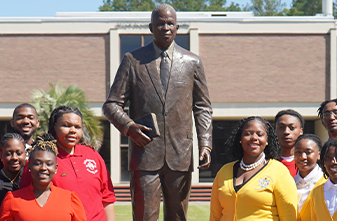
In 1877, the Baptist Educational, Missionary and Sunday School Convention received a charter from the State of South Carolina. A vision that united a group of African American men during the Reconstruction Era became a reality in the creation of an organization to assist in improving the life for African American people. Regardless of the acquisition of the charter, it would take another twenty-eight years to move forward with their vision.
By 1905, with the named shortened to The Baptist Educational and Missionary Convention of South Carolina, the leaders appointed a Committee of Twenty-Four to find a location to build a college. In 1906, Dr. J.J. Durham was appointed educational secretary of the convention and soon became chairman. Under his leadership, the committee voted to name the college Morris College in honor of Reverend Frank Morris for his leadership and contributions. The committee then began seeking a location for the college, considering options in Anderson, Gaffney, and Sumter. At first, it seemed that the college would find a home in Anderson, but an agreement could not be reached for the property. The committee eventually settled on thirty-three-acres (33 acres) near North Main Street in Sumter as the permanent home for Morris College.
Finally established in 1908, Morris College was a testament to the perseverance of its founding fathers, a majority of whom had no formal education. The significance of the opportunity that Morris College represented for the African American community cannot be understated. The institution would represent an avenue “for the Christian and Intellectual Training of Negro youth.” In the early years, the school would provide instruction on elementary, high school, and college levels. The college offered a “normal” education for certification of teachers along with liberal arts studies and theological training. Nineteen-fifteen (1915) saw the first Bachelor of Arts degrees conferred on the first two graduates.
Over the first decades, the college continued to amend and modify its educational offerings. In 1929, the “normal” school program was discontinued followed by the elementary school in 1930 and the high school in 1946. The four-year degree offering was interrupted from 1930 to 1932 when the school operated as a junior college. The four-year program was reinstated in 1933 and continues today. The college, from its founding, has been integral in the training of ministers and teachers in the state and abroad, bringing to fruition the vision of its founders. Today, Morris College continues its legacy as a historically Black institution with full accreditation as a four-year college.
Morris College has been led by eleven presidents in its storied history–all of whom have left their mark on the institution, contributing to its growth and development. Dr. E.M. Brawley served as the first president beginning in 1908, undertaking the work of setting the foundation of the school’s mission.
After the resignation of Dr. E.M. Brawley in 1912, Dr. E.D. White, General Secretary of the Baptist Educational and Missionary Convention, sought out Dr. J.J. Starks to become Morris College’s second president. He was duly elected by the convention on October 1, 1912.
Dr. Starks arrived at Morris in November of 1912 to find the college in near financial collapse. He immediately began eliminating the college’s debt. He focused on improving the curriculum to expand programs for students who wanted to pursue teaching careers. In 1915, he was awarded the first two bachelor’s degrees to Dorothy Hadden and Frank DeLaine. Under his direction, the college grew significantly with the incorporation of a new liberal arts curriculum. By the 1920-21 academic year, Morris College enrolled 1200 students.
The college continued to be successful under the guidance of Dr. Starks. In 1924, the college added a Department of Vocational Studies that included programs including dressmaking, farming and livestock practices, domestic science, and book-keeping. By 1926, Morris College had established a Department of Education. Dr. Starks continued fundraising for the institution until his resignation in 1930 to accept the presidency at Benedict College. The same year, Morris College was relegated to junior college status and entered into an agreement called “The Compact” with Benedict College.
In 1930, Dr. Ira David Pinson took over the leadership of Morris College while the nation was amid the Great Depression. Morris College had recently entered “The Compact” with Benedict College and was designated a junior college as a result. Benedict College agreed to relinquish its high school if Morris College would continue as a junior college. This agreement lasted until 1932.
Dr. Pinson was a gifted orator and charismatic leader for the college during his tenure. He provided oversight for the restoration of Morris College’s four-year program in 1932, the continued strengthening of curriculum, as well as the creation of intercollegiate sports for the college with football and baseball memberships in South Atlantic Intercollegiate Athletic Association. In addition, students were given recreational opportunities with basketball, tennis, and golf.
Under Dr. Pinson, the liberal arts program was expanded, the music program added a brass band and orchestra, and student organizations were created during the 1937-38 academic year. Dr. Pinson’s success included the addition of Brawley-Starks Hall as a new men’s residence hall. He continued to solicit support and work with the Baptist Educational and Missionary Convention until his untimely death in 1939.
Dr. James P. Garrick assumed the presidency of Morris College following the death of Dr. Ira David Pinson in 1939. He realized the need for financial stability emerging from the Great Depression and quickly raised $3000 to aid the college. In the 1940-41 academic year, he created a three-week institute for midwives and a summer institute for teachers. Summer session offerings would increase the following academic year. Dr. Garrick provided oversight for the elimination of the high school programs at Morris College in the 1942-43 academic year. He resigned as president in 1946 due to failing health.
Dr. Henry H. Butler became president of Morris College in 1946 as the world had started to recover from World War II. He immediately set out to tackle the college’s financial issues and threats to the teacher training program by the State Department of Education. Dr. Butler worked diligently during his two-year tenure to provide the college with financial stability. He was a mentor for future Morris College president Dr. Luns C. Richardson. Upon his death in 1948, Morris College was seeking an “A” financial rating and was in excellent financial standing.
Dr. Jeff W. Boykin was appointed president of Morris College in 1948 for one semester after the death of Dr. Butler. He was one of the founders of the college and served a long tenure as the Chairman of the Board of Trustees. He was successful in helping the college transition to the next academic year.
In the fall of 1948, Dr. O.R. Reuben was appointed the seventh president of Morris College. He was the youngest president in the college’s history serving for twenty-two years. Immediately he was faced with low student enrollment of 419 students. During his tenure, he initiated the building of new facilities on campus and the creation of policies geared toward acquiring full accreditation for the college.
Dr. Reuben implemented a program of financial assistance for faculty to pursue graduate and post-graduate studies. In the 1951-52 academic year, he led the process of gaining full accreditation for the college with his “Full Steam Ahead” policies. In 1961, the word “Negro” was removed from policy, opening the college to all ethnic groups.
Campus improvement and new facilities positively marked Dr. Reuben’s tenure. In 1950, the Student Center was built, the Garrick-Boykin Gymnasium and the H.H. Butler buildings were constructed. In 1954, the campus added the Mabel K. Howard building and in 1964, the G. Goings Daniels Hall. During 1967, the completion of the Wilson-Booker Science Building and the Dobbins-Keith Whitener Hall was realized. Dr. Reuben added the Athletic Stadium and perimeter fence to the campus, and student enrollment increased to 898 by the 1960-61 academic year. Dr. Reuben’s death in 1970 ended his long successful tenure.
Dr. Henry E. Hardin was appointed as Morris College president in 1972. His short tenure was marked by student unrest after the assassination of Dr. Martin Luther King, Jr. and the Civil Rights struggle. Under his tenure, he implemented the Upward Bound program, a new liberal studies major, and the Cooperative Education Program. Morris College became eligible for accreditation by the Commission on Colleges of the Southern Association of Colleges and Schools in December 1973.
Dr. Luns C. Richardson became the ninth president of Morris College in 1974. He would serve the longest tenure to date of forty-three years. Immediately, he faced the challenge of acquiring accreditation for the college and restoring its financial stability. Morris College received accreditation in December of 1978. In 1980, Dr. Richardson spearheaded the construction and completion of the L.C. Richardson-W.A. Johnson Learning Resources Center.
When Dr. Richardson accepted the leadership of Morris College, the student enrollment had fallen to 242 students. The policies he implemented increased student enrollment by 182% in 1997. He was successful in implementing new academic programs which included criminal justice, early childhood education, and health science. He created the Division of Religion and Humanities which offered the Pastoral Ministry Program.
Under Dr. Richardson’s leadership faculty grew numerically with seventy members of which 63% earned or held a doctoral degree. Dr. Richardson built campus facilities, increased student enrollment, fostered student involvement, and led Morris College to continued success until 2017. Dr. Richardson died in January of 2018 realizing the success of Morris College.
Dr. Leroy Staggers was appointed president of Morris College in 2017. Despite having to address legal issues and the complications brought by the COVID 19 pandemic, he continued the path of excellence for the college. He was able to implement new programs in e-sports, cybersecurity, and supply chain management. Dr. Staggers guided the college through the reaffirmation of accreditation, and he concluded his seven-year tenure on June 30, 2024.
In July of 2024, Dr. Said Sewell was appointed the eleventh president of Morris College. As President of Morris College, Dr. Sewell implemented a transformational plan for Morris called “Elevate Morris.” This seven-point plan propels the institution into a new era of growth and excellence. Believing in leading by example, he launched this plan by moving into a freshman residential hall. Under his leadership, Morris College is investing over four million dollars in necessary campus improvements to create a vibrant campus for students, focusing on enrollment management, and supporting faculty and staff development. As he continues to lead Morris College, Dr. Sewell remains dedicated to the values of integrity, inclusivity, and impactful education, which are the cornerstones of his presidency. President Sewell and his team have implemented strategies to recruit new students and increase enrollment. Dr. Sewell’s transformational plan for 2026-27 is “Momentum: The Morris Movement” to continue his leadership as beacon for student success with the creation of a Morris Honors College, student career preparation and workforce partnerships, reframing the curriculum with innovative academic programs including generative AI with IBM, law enforcement cultural competency training, the development of Alek-the Math Emporium, faculty/staff development, financial stability with the goal of raising two million dollars, improving campus security, and increased strategic institutional branding. Because of President Sewell, the future of Morris College is brighter than ever.